

French Drain or Surface Drain? What Tarrant County Yards Actually Need
Published at September 30, 2026 | Category: Drainage Services
Here is the short answer. If water stands on top of the ground, in a low spot, on a patio or against the house, you need a surface drain. If the ground itself stays soggy for days and turf will not grow, you need a French drain. If both are true, which is the case in a lot of Tarrant County yards, you need both, sharing one outlet. The rest of this post explains why, and how Fort Worth’s clay soil and rainfall pattern change the answer.
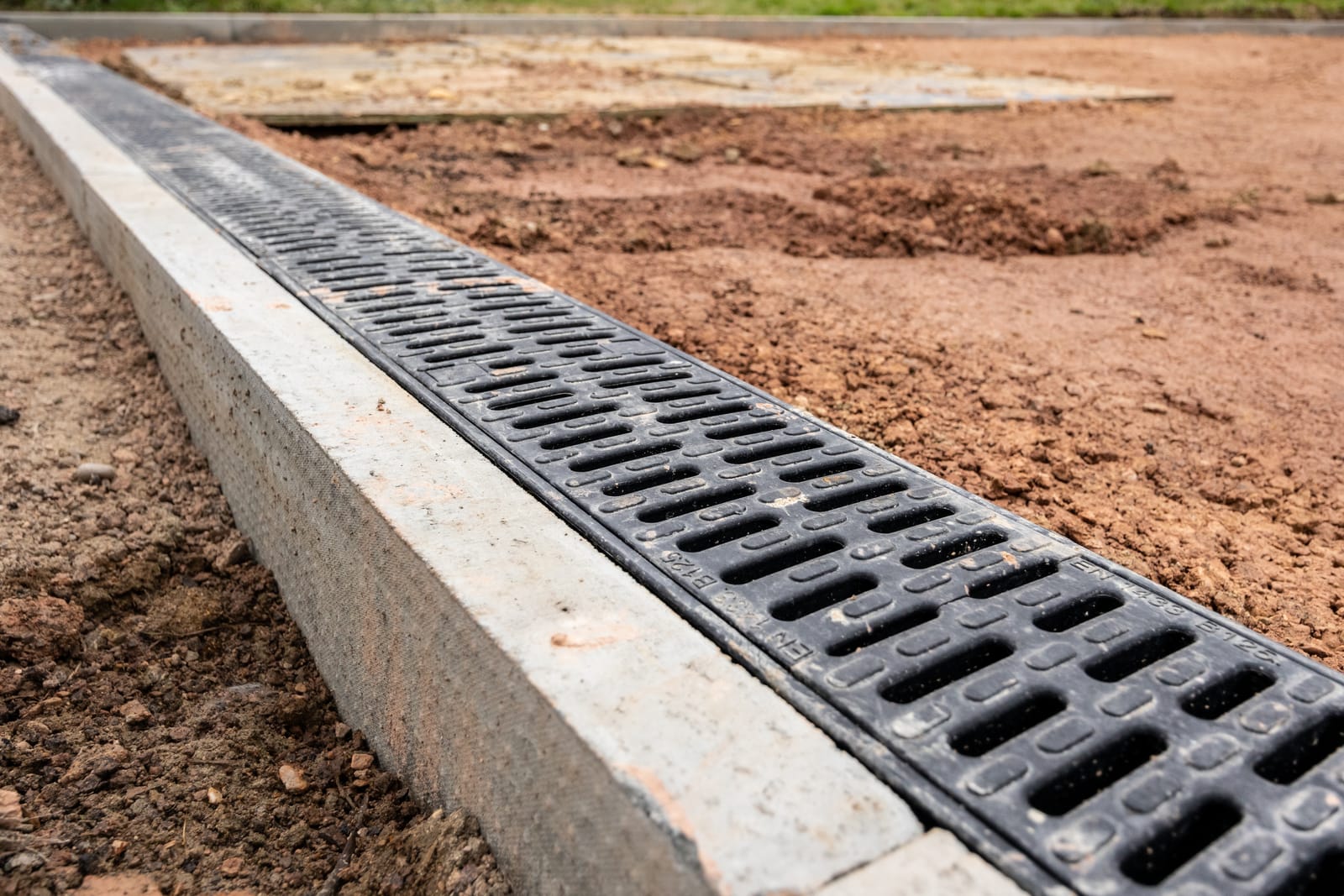
What Is a Surface Drain?
A surface drain is a grated inlet set at the lowest point of an area, connected to solid pipe that carries water to an outlet. Catch basins in a lawn, channel drains along a patio edge or driveway, and downspout drains are all forms of surface drainage. They move water that is already on top of the ground. They do nothing for water in the soil.
Greenview installs these as surface drains for lawns and beds and channel drains for hard surfaces.
What Is a French Drain?
A French drain is a trench lined with filter fabric, filled with washed gravel and fitted with perforated pipe on a consistent slope. Water in saturated soil moves into the gravel, drops into the pipe and flows to an outlet. It lowers the water level in the ground. It does not catch water running across the surface very well, because grass and mulch sit on top of it.
Our French drain installation page covers construction details.
Why Tarrant County Yards Have Both Problems
Clay soil
Most of Fort Worth and its suburbs sit on expansive clay. Texas A&M AgriLife’s Earth-Kind program explains that in fine-textured soils like clay, water spreads laterally before it penetrates very deeply. Rain that would soak straight down in sandy soil instead spreads sideways just below the surface. The result is two problems at once: puddles on top because the ground cannot absorb fast enough, and saturated soil underneath that stays wet for days.
Rainfall in bursts
The National Weather Service lists a normal annual rainfall of 37.01 inches for Dallas-Fort Worth, with May at 4.78 inches and October at 4.37 inches. That water does not arrive evenly. A spring storm can drop a large share of a month’s total in an afternoon, which overwhelms surface capacity and then keeps the clay saturated for a week.
Local drainage limits
The City of Fort Worth’s stormwater program notes that most reported flooding in the city happens outside FEMA-designated floodplains, in areas where the local storm drain system cannot keep up. In other words, your lot’s own drainage is doing more of the work than you might expect.
How to Tell Which One You Need
Signs you need a surface drain
- Water pools in a visible low spot after rain and drains within a day or two
- Water sheets across a patio or driveway toward the house
- Downspouts dump onto a bed or walkway
- Mulch washes out of beds in storms
- The problem shows up only during and right after rain
Signs you need a French drain
- The ground is spongy days after the rain ends
- Turf thins or dies in one section every year
- Moss or algae grows in a shaded side yard
- Soil pulls away from the slab in summer and heaves in winter
- Fence posts rot at the base along one line
- Retaining walls lean or weep through the joints
Signs you need both
- A low spot that puddles and stays soggy for a week
- Water standing against the foundation after storms and damp soil there in between
- A backyard at the bottom of a slope receiving runoff from uphill lots
Side-by-Side Comparison
Question | Surface Drain | French Drain |
What water does it handle? | Water on top of the ground | Water in the soil |
Where does it go? | Low points, patio edges, driveways, downspouts | Across wet zones, along foundations, behind walls |
How fast does it work? | Immediately during rain | Over hours and days as soil drains |
Visible parts | Grates or channel covers | Usually none once sod is restored |
Typical Tarrant County use | Patios, pool decks, driveways, low lawn spots | Foundations, side yards, sloped lots, retaining walls |
Best result | Combined with French drain when soil is also saturated | Combined with surface inlets when water also pools |
A Common Tarrant County Example
Picture a Keller or Bedford backyard with a patio against the house and a fence at the low end of the lot. After a storm, water sits on the patio corner nearest the house and the strip of lawn along the fence stays mushy for a week. The patio corner is a surface problem: a channel drain along the patio edge or a catch basin at the corner solves it. The fence line is a soil problem: a French drain along the fence lowers the water table there. Both connect to one solid pipe that runs to a pop-up emitter at the curb. Fix only the patio and the lawn keeps dying. Fix only the lawn and the patio keeps puddling.
Can You Do It Yourself?
A single downspout extension or a small catch basin at a bed edge is a reasonable weekend project. Trenching a French drain is not, for three reasons. First, slope has to be consistent from inlet to outlet, and a trench that is dug to a depth rather than to a grade will hold water instead of moving it. Second, fabric and washed gravel have to be used correctly or clay fines clog the pipe within a few seasons. Third, underground utilities have to be located before digging. Sloped lots, foundation work and anything behind a retaining wall belong with a contractor.
Where the Water Goes Matters as Much as How It Is Collected
Both drain types need a legal discharge point: the curb, an existing storm inlet or a dry well on your property. Water cannot be routed onto a neighbor’s lot. When no gravity outlet exists, the EPA’s Soak Up the Rain program describes rain gardens as depressed planted areas that collect runoff and let it soak into the ground, and a bioretention area or dry well can serve the same role at the end of a drain line. Getting this decision right is what keeps a drainage system working after the first year.
Our Approach in Tarrant County
Greenview walks the property, ideally during or right after rain, and maps where water arrives, where it collects and where it can exit. Most of the systems we build in Fort Worth, Keller, Bedford and the western suburbs combine surface inlets at the wet spots with a French drain through the saturated zone, all on one outlet line. Drainage goes in before any patio or planting so no finished surface has to be cut later. Our post on slope correction without major disruption covers what happens when grading is part of the fix.
When to Call Greenview
If your yard shows any of the signs above, or if a previous drain has stopped working, we can tell you which system you need and why. Greenview Landscaping is licensed and insured, BBB A+ accredited and has been installing French drains, surface drains and channel drains across Fort Worth and Tarrant County since 2016, with 4.8 stars on 184 Google reviews. Call (817) 393-3144 or contact us online to schedule a drainage estimate.