


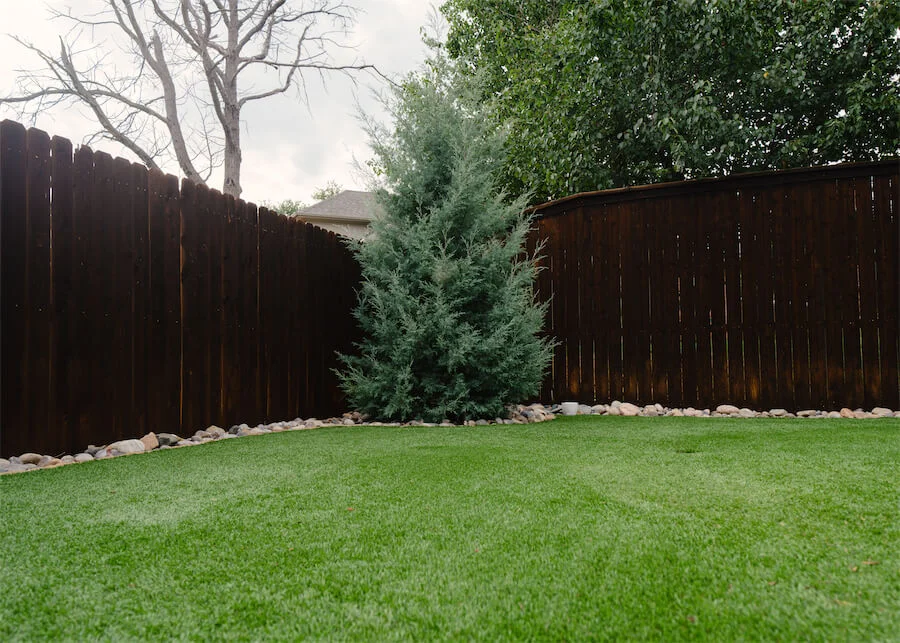


Artificial turf earns its place in a Fort Worth yard when natural grass has already lost the argument: the deep shade under a mature live oak where nothing fills in, the dog run worn down to bare clay, the narrow side yard nobody wants to drag a mower through, the pool surround that tracks clippings into the water every weekend. Greenview Landscaping installs artificial turf and synthetic grass across Fort Worth and the surrounding Tarrant County communities, built on an engineered base designed for the clay soil that ruins most turf installations within a season. Operating since 2016 with a 4.8-star Google rating and A+ BBB accreditation, we handle turf as part of a complete landscape rather than as a product drop, which means the drainage, the grading, and the transitions into patios and beds are designed together. Browse finished projects in our gallery or read client accounts on Yelp. Call (817) 393-3144 or request your free artificial turf estimate, and every proposal breaks out demolition, base, turf, infill, and labor before anything gets scheduled.
Where Artificial Grass Works Best in Fort Worth
Turf is a tool, not a religion. These are the applications where it consistently outperforms sod in North Texas.
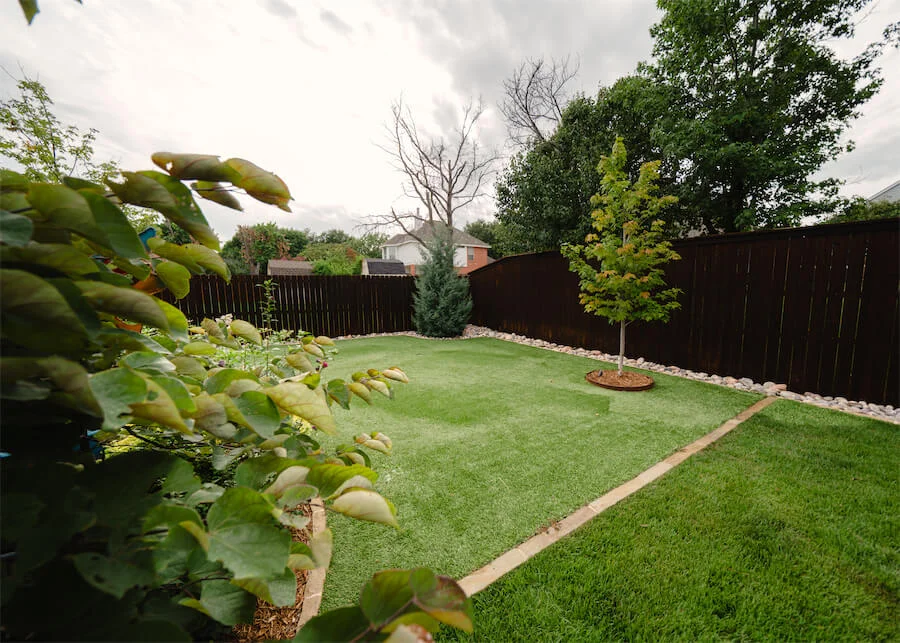
- Back and front lawns – Full yard artificial grass for homes where watering restrictions, heavy shade, or travel schedules make a living lawn a losing battle.
- Pet turf and dog runs – A permeable base and ammonia-capturing infill turn the muddiest part of the yard into the cleanest.
- Backyard putting greens – Practice greens with real contour, fringe collar, and a chipping approach, tuned to the speed you actually play.
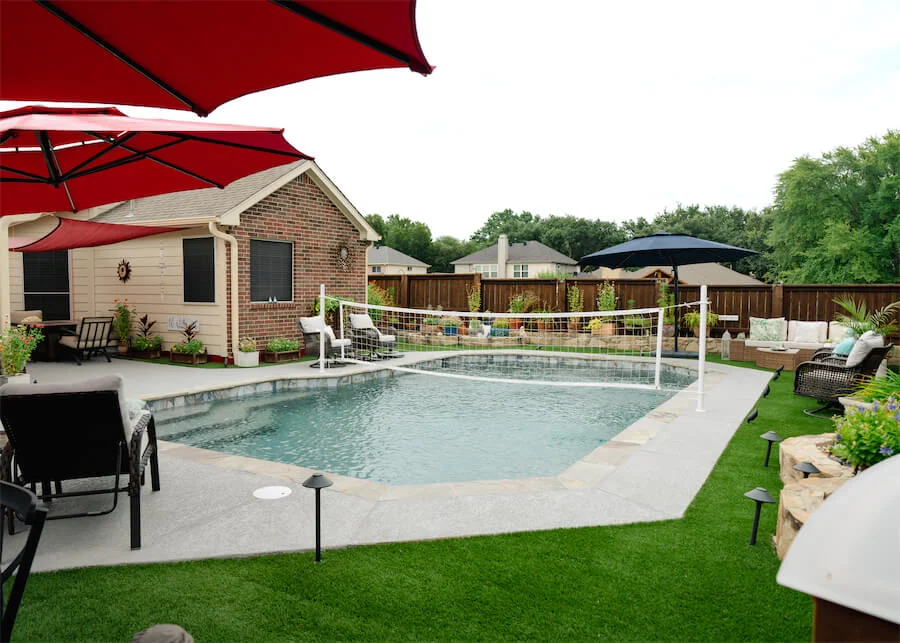
- Pool surrounds – Chlorine-resistant turf that keeps clippings out of the water and stays green in the shaded strips where sod thins out.
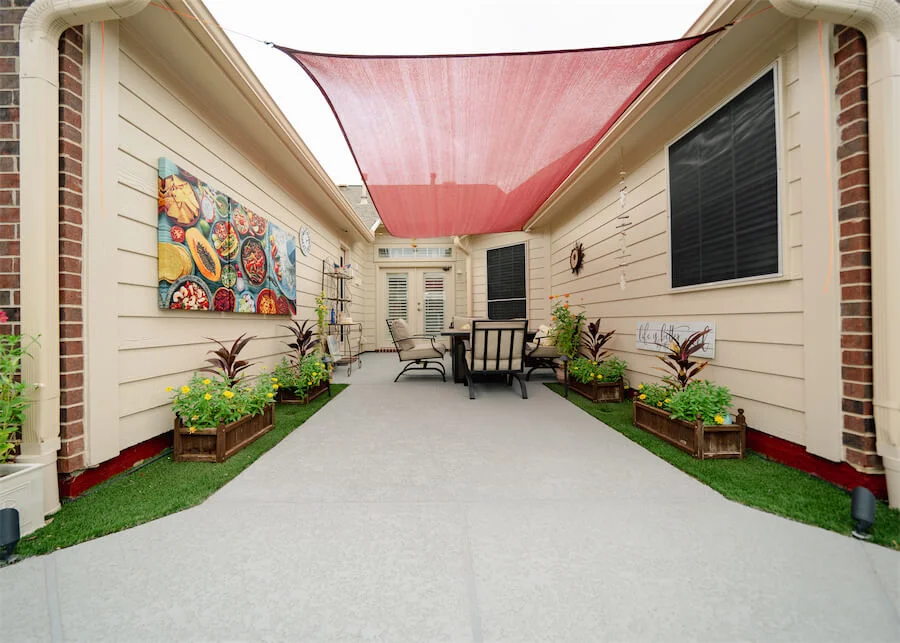
- Between pavers and along patios – Turf joints between flagstone or concrete pavers give the look of a grass seam with none of the trimming.
- Playgrounds and play areas – Cushioned underlayment beneath the turf softens falls and eliminates the mud that follows every rain.
- Side yards and narrow strips – The spaces too small to irrigate well and too awkward to mow.
- Commercial properties – Office parks, multifamily amenity areas, restaurant patios, and retail entries where appearance has to hold up under constant foot traffic.
What Artificial Turf Costs in Fort Worth
Most turf companies will not publish a number. Here is ours, with the reasoning attached.
Installed artificial turf in Fort Worth runs roughly $9 to $18 per square foot. A simple rectangular back lawn with easy access and no drainage work sits near the bottom. A yard with curved beds, tree wells, a paver transition, and a drain tie-in sits near the top. Backyard putting greens run $15 to $25 per square foot, because the base is built to tighter tolerances and the contours are shaped by hand.
That price covers removing the existing lawn and hauling off the spoil, building and compacting the base, installing the turf with proper seaming and edge fastening, and spreading infill. Turf sold by the roll looks far cheaper per square foot because it excludes every one of those steps, and those steps are the installation.
The math that matters is the ten year one. A 1,500 square foot Fort Worth lawn costs real money every summer in water, mowing, fertilizer, and reseeding. Turf front-loads that spending into a single number and then stops. Whether that trade makes sense depends on your yard, and we will tell you plainly when we think sod is the better answer.
The Base Is the Job
Turf failures in Tarrant County almost never start with the turf. They start three inches below it.
Fort Worth sits on expansive clay that swells when it takes on water and shrinks when it dries out. Over a single North Texas year that soil moves enough to ripple a turf lawn that was laid straight onto it, and once the surface goes wavy the only fix is to pull everything up and start over. The base is what isolates the turf from that movement.
We excavate three to four inches, then install crushed stone or decomposed granite in lifts, compacting each layer before the next goes down. A base dumped in one pour and rolled once compacts unevenly and settles into ruts under traffic. The base is then graded to shed water toward a designed outlet rather than toward the house, and on yards with existing drainage problems we tie a French drain or channel drain into the base before the turf goes down.
That last part is where a landscape contractor differs from a turf-only installer. Drainage work is already what we do. When water is the underlying problem, we solve it in the same excavation rather than sending you to a second contractor after the turf starts holding puddles.

Turf Specifications Worth Asking About
Most turf websites describe their product as premium and leave it there. These are the four numbers that actually predict how an installation will look in year eight.
Face weight is ounces of yarn per square yard, and it is the single best predictor of durability. Below 50 ounces the fibers mat down under family traffic and never stand back up. For a lawn that gets regular use, look for 60 ounces or higher.
Pile height is blade length. For a residential lawn, 1.5 to 1.75 inches reads most naturally. High traffic lanes and pet runs do better around 1.25 inches because shorter blades mat less. Putting greens run near 0.5 inches so the ball rolls true.
UV stabilization is the package built into the fiber that resists Texas sun. It is the difference between turf that holds color for fifteen years and turf that goes yellow-gray in four. Replacing someone else’s faded installation is a recurring line of work for us, and it is nearly always a product decision made to hit a price.
Drainage rate through the perforated backing should be around 30 inches per hour, which is far more than any North Texas storm delivers. Once the backing clears that bar, drainage performance is entirely a function of the base beneath it.
The Honest Downsides
Artificial turf gets hot. On a 100 degree August afternoon in full sun, surface temperature can reach 140 to 160 degrees, well above natural grass. It cools within minutes in shade or after a rinse from a hose, but anyone who tells you turf stays cool is selling. We design around it by keeping turf out of unshaded dog runs where the layout allows, specifying lighter infill that reflects heat rather than storing it, and recommending shade where a family plans to use the space at midday.
Turf also costs more up front than sod, and it does not cool the surrounding air the way living grass does. A large sunny lawn where Bermuda or Zoysia would thrive with normal care is usually better off staying alive. We would rather say that during the estimate than install something you regret in July.
Turf as Part of the Whole Yard
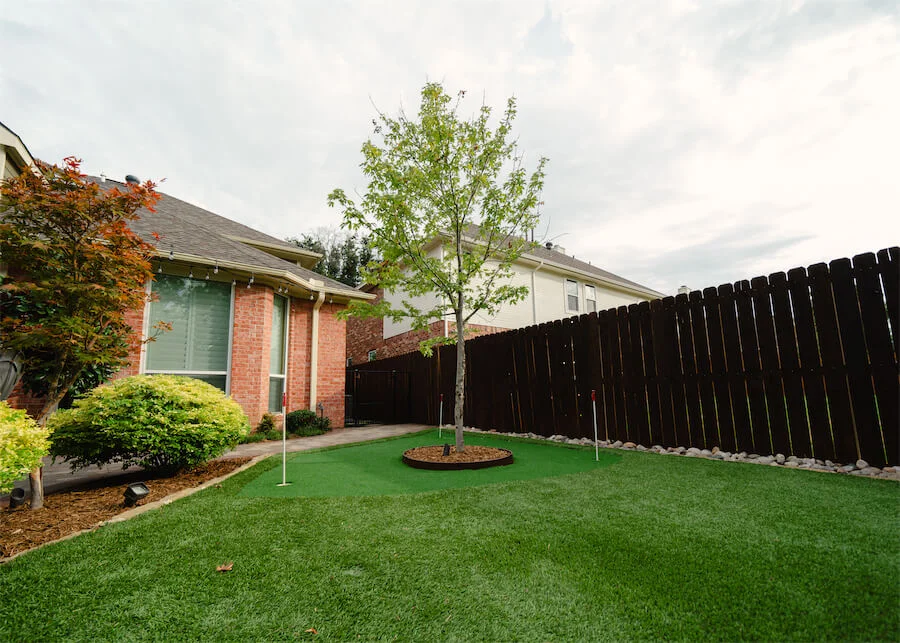
The installations that look best five years later are the ones where turf was designed alongside everything around it. Where the turf meets a patio or a flagstone walkway, the two surfaces should finish flush, with the paver base and the turf base built as one system rather than butted together by two different crews. Where turf meets a planting bed, a steel or masonry edge holds the line and keeps mulch off the fibers. Where turf wraps a mature tree, the well around the trunk gets sized to the tree and the base stays permeable inside the drip line so rain still reaches the roots.
Greenview builds the hardscaping, the masonry edging, the drainage, and the turf, which is why those transitions are detailed rather than improvised.

Backyard Putting Greens
A putting green is the one turf application people buy for pleasure rather than for maintenance relief, and it is worth building properly. We shape contour into the base rather than laying a flat pad and calling it a green. Cup placement is planned around approach angles so a 200 square foot green still gives you several genuinely different putts. Green speed comes from turf selection, infill depth, and rolling, and we set it to how you play instead of to a number on a brochure. Fringe collar and a chipping approach turn a putting surface into a short game area.
HOA Approval in Tarrant County
Texas law limits how far a homeowners association can restrict water-conserving landscaping, but associations retain real authority over appearance, materials, and front yard placement. Southlake, Colleyville, Trophy Club, and Westlake associations tend to review front yard turf applications closely. We supply product specifications, base detail, and photos for your submission packet, and we schedule installation after your approval comes through rather than before.
How the Project Runs
- Free on-site estimate. We measure, check grade and drainage, talk through how the space gets used, and leave you with an itemized written estimate.
- Product selection. You see and feel samples at the face weights and pile heights we recommend for your specific application.
- Demolition and base. Existing lawn out, spoil hauled off, base installed in compacted lifts and graded to drain.
- Installation. Turf placed, seamed, fastened at every edge, then infill spread and brushed in.
- Walkthrough. We go over maintenance, warranty terms, and what to expect through the first summer.
Maintaining Artificial Grass
Maintenance is light but it is not zero. Rinse occasionally, brush the high traffic lanes against the grain a few times a year to keep the fibers upright, blow or rake off leaves before they break down into the infill, and top up infill every few years as it settles. Pet areas want a more frequent rinse through the summer. Plan on a professional deep clean and infill refresh every two to three years, which we handle for clients across Fort Worth, Keller, Colleyville, and Southlake.
Why Greenview Landscaping
We are a landscape contractor that installs turf, not a turf franchise that subcontracts landscaping. That difference shows up in the base work, in the drainage, and in every place the turf meets something else. We have built hardscape, drainage, and planting for Fort Worth homeowners since 2016, and we bring the same engineering approach to a turf lawn that we bring to a retaining wall. If turf is not the right answer for your yard, we will say so during the estimate.
FAQs About Artificial Turf in Fort Worth
How much does artificial turf cost in Fort Worth?
How much is 1,000 square feet of artificial turf installed?
How long does artificial turf last in Texas?
Does artificial turf get hot in Fort Worth summers?
What is the downside to artificial turf?
Is artificial grass worth it in North Texas?
Does artificial turf drain during heavy rain?
How do you install turf over Fort Worth clay soil?
What infill do you use?
What pile height should I choose?
Is artificial turf safe for dogs?
Does dog urine make turf smell?
Do I need HOA approval for artificial turf in Tarrant County?
Can you install turf around a pool?
Can you put artificial grass between pavers?
Can artificial turf go on a patio or balcony?
Do you build backyard putting greens?
How much does a backyard putting green cost?
Will artificial turf harm a tree it surrounds?
How long does artificial turf installation take?
Do you offer commercial artificial turf in Fort Worth?
Do you install sports turf or practice areas?
How do I clean and maintain artificial grass?
Does artificial turf fade in the Texas sun?
Can turf be installed over an existing lawn or over concrete?
What warranty comes with your artificial turf?
Can you replace turf another company installed badly?
Which cities do you install artificial turf in?
Does Greenview Landscaping offer free artificial turf estimates?
Ready for a Yard That Stays Green
Artificial turf solves specific problems very well: shade, pets, water bills, and the parts of a yard that have defeated sod for years. Greenview Landscaping builds it on a base engineered for Fort Worth soil and finishes it into the rest of your landscape rather than dropping it on top.
Contact us today to schedule your free artificial turf estimate and we will tell you honestly whether turf is the right call for your yard.